Redcoast: Digital Practice in the Process Industry under SOPHON’s Framework

红岸未来2026-02-26
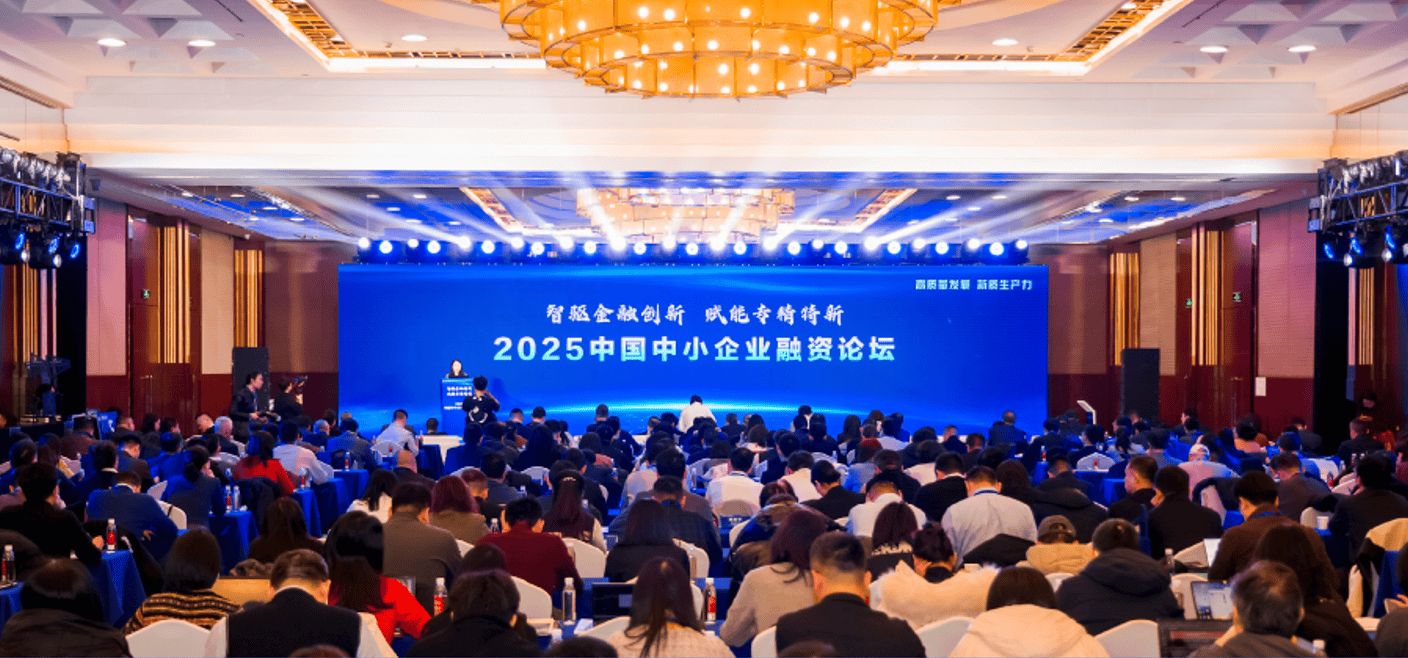
Recently, SOPHON’s innovative practices and phased achievements in the field of smart manufacturing have garnered industry attention. At the 2025 China SME Finance Forum hosted by China Center for Promotion of SME Development, SOPHON was selected as one of the first batch of enterprises to participate in the “Premier Platform for SME Innovation Achievements.” As a representative enterprise in smart manufacturing, it comprehensively showcased its latest progress in technology R&D, product innovation, and industrial application.
Against this backdrop, Redcoast has also gained a clearer understanding of its own position and responsibilities. As a digital business entity deeply aligned with SOPHON in terms of technology systems and industrial direction, Redcoast is rooted in the real-world production scenarios of the process industry. It is committed to transforming its deep expertise in processes, equipment, and engineering into replicable digital twin and intelligent capabilities, driving the process industry towards higher quality and greater certainty.
As a wholly-owned subsidiary of SOPHON, Redcoast was born at a critical stage in the continuous and deepening evolution of intelligent manufacturing in China. We find ourselves in an era not defined by “whether to digitize,” but by “how to truly implement digitalization on the front lines of production and create sustainable value.”
In the process industry, characteristics such as complex materials, multi-process coupling, continuous production, and high safety requirements determine that its digital transformation cannot simply replicate the path of the discrete industry. It is against this industry backdrop that Redcoast has established its development direction—taking digital twins as the core capability hub to bridge the gaps between processes, equipment, data, and decision-making, and driving the process industry’s transition from “experience-driven” to “data and model-driven.”
I. Building on the industry expertise of SOPHON, Redcoast extends its reach to bridge the critical ‘last mile’ of industrial application.
SOPHON has long been deeply engaged in core equipment, material processes, and automation systems for the process industry, establishing a complete technology framework featuring “materials-processes-equipment-systems” in fields such as new energy, new materials, chemicals, and pharmaceuticals. This has laid an extremely solid foundation for the birth of Redcoast.
However, through extensive customer practice, we have also clearly observed: Advanced equipment and automation systems solve the problem of “whether it can be done,” but do not necessarily address the issue of “how to consistently do it well.”
The stability of production processes, the root causes of yield fluctuations, the evolution path of equipment degradation, and the nonlinear relationship between process parameters and product quality still largely rely on empirical judgment. Data exists but is not “understood”; systems are not lacking but are fragmented from one another.
Redcoast emerged precisely to fill this gap. Rather than reinventing hardware, we build upon SOPHON’s years of accumulated engineering and process expertise to digitize, model, and platformize the equipment. In this way, we aim to transform the tacit knowledge hidden in the equipment, systems, and personnel into digital assets that can be calculated, simulated, and continuously optimized.
II. Core Business Direction: Three Capability Systems Centered Around Digital Twin System
Driven by the real pain points of the process industry, Redcoast has gradually developed a clear and focused business structure.
1. Process-Level Digital Twin System: Making Complex Production Process “Comprehensible”
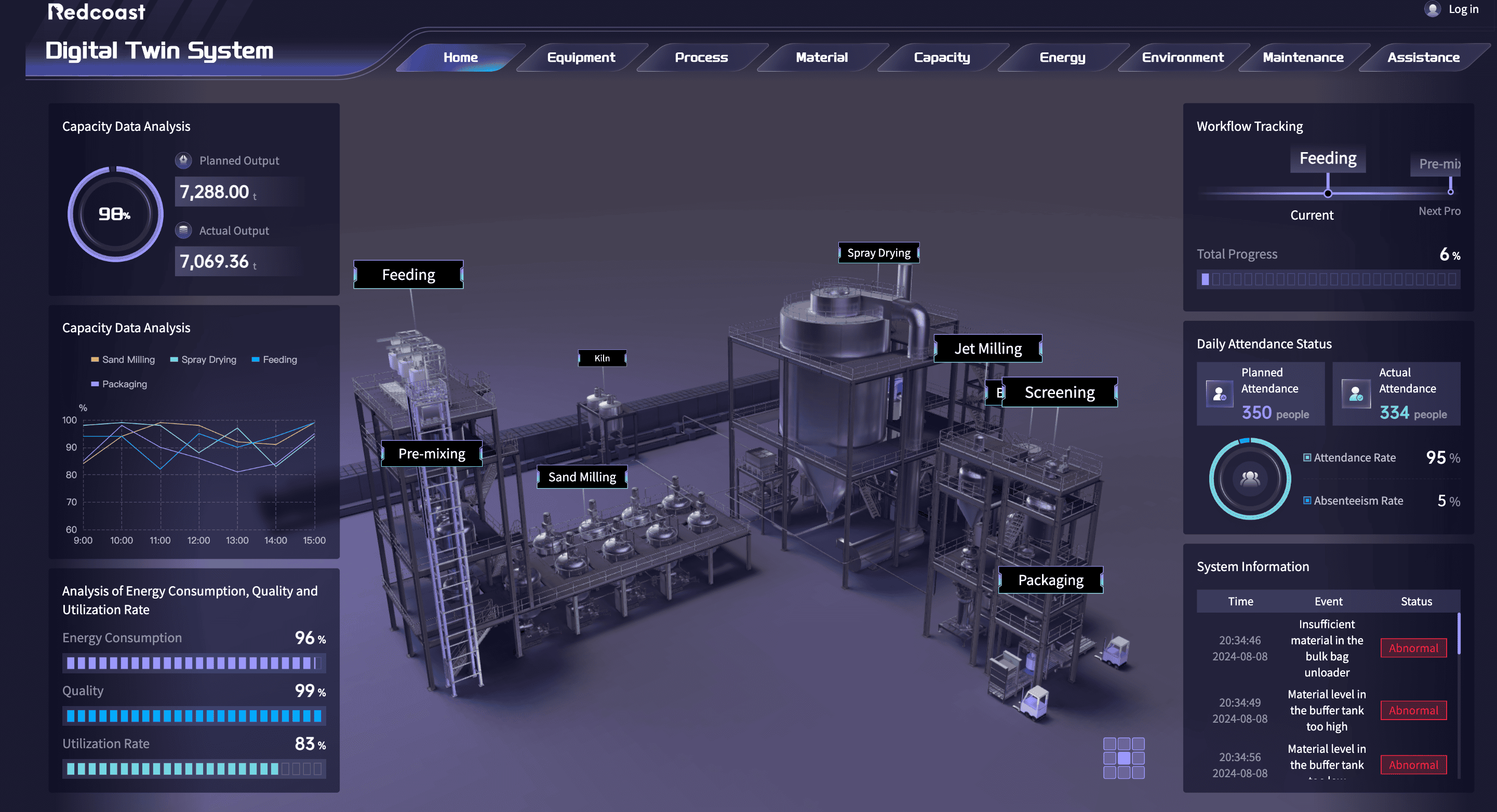
Unlike mere “digital dashboards” that focus only on visualization, Redcoast emphasizes digital twins that integrate processes with data. Based on actual process flows, we construct multi-layered models covering materials, power, equipment status, and control logic to enable:
- Real-time mapping of process status and deviation identification
- Simulation of the impact of parameter changes on quality and capacity
- Visual restoration and post-mortem analysis of abnormal operating conditions
This enables enterprises, for the first time, to “see” the internal logic behind production process, not just the outcome data.
2. Digitization of Equipment and Maintenance: From Reactive Repairs to Predictive Decision-Making
In the highly continuous process industry, equipment issues are often not a matter of “if” they will occur, but “when” they will occur and “how significant” their impact will be.
Redcoast integrates equipment operating data, process stresses, historical failures, and maintenance records into a unified digital twin system to build equipment health models, enabling:
- Trend prediction for critical equipment status
- Early anomaly warning and risk classification
- A shift in maintenance strategies from “rule-of-thumb decisions” to “data-assisted decision-making”
This not only reduces the risk of unplanned downtime but also provides a foundation for enterprises to establish long-term asset management capabilities.
3. Integration of Data Middle Platform and System: Bridging the Gap Between IT and OT
We are keenly aware that: Without system integration capabilities, digital twins remain stuck at the “demonstration layer.”
Therefore, in its project practices, Redcoast places great emphasis on IT/OT convergence. By building a unified data governance and business model framework around systems such as MES, DCS, PLC, LIMS, and ERP, we ensure that data truly serves the closed loop of production, management, and decision-making.
III. Market Positioning: Deepening Roots in the Process Industry and Expanding to Global Application Scenarios
In its market strategy, Redcoast has not chosen “horizontal expansion across industries,” but instead insists on prioritizing the process industry and deeply cultivating key sectors.
Key Industry Focus Areas
- New Energy Materials (cathode/anode materials, materials related to solid-state battery)
- Chemical & Fine Chemical Industry
- Pharmaceuticals & Functional Materials
- Advanced Powder & Advanced Materials
These industries share highly similar process complexities and digitalization challenges, making them the scenarios where the value of digital twins can be most readily unleashed.
Collaborating with Global Networks
Leveraging the established international layout of SOPHON, we are progressively engaging in overseas projects and technical collaborations. In regions such as Europe, North America, and Southeast Asia, we are working with local partners to explore the adaptation and implementation of digital solutions, laying the groundwork for future international expansion.
IV. Looking Toward 2026: Redcoast’s Phased Roadmap
At this current juncture, we have a clear and pragmatic vision for our development goals in 2026.
1. Evolving from “Project-Based Delivery” to “Platform-Based Products”
Alongside ongoing project delivery, we will further consolidate industry-generic models and modular capabilities, driving the evolution of our digital twin platform towards standardization and productization. This will reduce the costs for customers in both implementation and replication.
2. Strengthening Model Assets and Industry Knowledge Bases
Focusing on key industries, we will continuously accumulate process models, equipment models, and typical scenario libraries. This will elevate Redcoast’s core competitiveness from “implementation capability” to “knowledge and model assets.”
3. Forging Deeper Synergy with the Parent Company
We will establish a closer collaborative mechanism among equipment, process experimentation, and digital systems, truly achieving a closed-loop innovation from R&D to mass production and from the physical world to the digital world.
Conclusion: We are not Chasing Concepts, But Building Long-Term Capabilities.
Redcoast has always adhered to a fundamental conviction: Digital transformation is not a one-time project, but a long-term capability-building endeavor.
We are not eager to chase conceptual trends; instead, we focus on whether every digital model and every data link truly serves production itself. Supported by SOPHON’s deep technical expertise, Redcoast will continue to root itself in process industry sites, using digital twin as the “key” to gradually unlock the “black box” of complex manufacturing systems.
Looking ahead to 2026, we look forward to working with more industry partners to validate, co-build, and achieve win-win outcomes, forging a sustainable and replicable path for intelligent manufacturing upgrade in an uncertain industrial landscape.