From the “Lobster Farming” Boom to AI’s Real Entrance into Industrial Sites

Redcoast2026-04-13
Recently, a rather dramatic term—“lobster farming”—has suddenly become popular in the AI circle.
The “lobster” here does not refer to seafood, but rather to OpenClaw, an open-source autonomous agent. As a growing number of developers and enterprises begin to deploy and train their own agents, this process of “feeding data—shaping capabilities—gradual growth” has been vividly termed “lobster farming.” The phenomenon quickly went viral in the tech circle and has sparked a new round of discussion in the industry about the real-world application and deployment of AI agents.

In fact, what this trend reflects is not merely technological interest, but rather a critical transition of AI from a tool to an executing entity.
I. From “Able to Answer” to “Able to Act”: A New Stage for AI Agents
In the past few years, the development of large language models has primarily focused on language understanding and generation capabilities. AI has become good at answering questions, writing codes, and generating content, but in essence, it remains at the stage of a “conversational tool.”
The next-generation agent system represented by OpenClaw, however, attempts to help AI take this step forward.
By connecting large language models with local tools, system resources, and automation tasks, OpenClaw enables AI not only to think but also to directly execute actions—such as invoking tools, running scripts, processing files, and even automatically completing task workflows.
Its core architecture adopts a layered design of Gateway—Agent—Workspace, and uses mechanisms such as behavior rule files and memory files to constrain the agent’s behavioral logic, gradually giving AI the form of a “digital employee.”
What is more important, OpenClaw has the capability of continuous operation: through timing mechanisms and background loops, the agent can autonomously execute tasks, monitor system status, and trigger operations 24/7.
This means that AI is no longer just passively responding to instructions, but is beginning to become an execution entity capable of continuous work.
This is precisely the core appeal behind the concept of “lobster farming”: People are not using a piece of software; they are cultivating a gradually growing AI assistant.
II. The True Value of AI Agents: Entering Complex Scenarios
While the “lobster farming” craze has generated significant excitement among developers, what is more noteworthy is that it is driving the extension of AI into complex industry-specific scenarios.
Research institutions project that the global AI agent market will reach $47.1 billion by 2030, with a compound annual growth rate (CAGR) of nearly 45%.
Among the many industries, manufacturing and the process industry are widely regarded as one of the most promising application scenarios.
The reason is very simple: Industrial systems contain a large amount of complex data, equipment, and processes—and these are precisely where AI agents can deliver value.
In traditional digital systems, large amounts of data are collected and stored, but the actual efficiency of data utilization is not high.
Enterprises often face three typical problems:
- Lots of data, but difficult to understand
- Many systems, but disconnected from each other
- Decisions rely on experience rather than real-time analysis
In other words, industrial systems have long lacked an “intelligent hub” capable of understanding data, connecting systems, and driving decision execution.
AI agents offer exactly such a possibility.
III. AI Begins to Understand “Equipment” and “Process”
If traditional AI mainly processes text and images, then the core of industrial AI is understanding equipment and process logic.
In the process industry, a production line often involves a large number of complex equipment, such as reactors, conveying systems, pump and valve systems, pipeline networks, and various sensors.
These devices continuously generate massive amounts of data, including:
- Temperature
- Pressure
- Flow rate
- Equipment vibration
- Energy consumption
- Process parameters
In the past, this data was often used for monitoring or report analysis. In the AI agent framework, however, data will no longer be merely records—it will become the real-time basis for decision-making and operations.
For example, an AI agent can continuously monitor equipment operating data and, based on historical models, determine abnormal trends:
- Whether equipment vibration is approaching a fault threshold
- Whether process parameters are deviating from the optimal operating range
- Whether a specific production step has an efficiency bottleneck
Once a risk is identified, the agent can not only issue an alert but also automatically trigger next-step actions, such as:
- Adjusting equipment operating parameters
- Pushing maintenance recommendations
- Generating production optimization plans
This capability, in essence, is the AI’s ability to understand and execute the “behavioral logic” of industrial systems.
IV. Digital Twin + AI Agent: A New Form of Industrial Systems
In the industrial sector, another important trend is the maturation of digital twin technology.
By creating real-time virtual models of equipment and production systems, digital twins enable the formation of synchronized mapping between the physical world and the digital space.
When digital twins and AI agents are combined, a new mode of industrial system operation emerges: Data → Model → Decision-making → Execution → Feedback In this closed loop, AI is no longer just an analysis tool—it becomes an integral part of the entire operational logic.
In this system:
- The digital twin is responsible for replicating equipment and system status
- The data platform is responsible for integrating various types of industrial data
- The AI agent is responsible for understanding, reasoning, and taking actions
For example, in pipeline conveying or pigging ball systems, the digital twin can simulate equipment operating status in real time, while the AI agent can assess pigging efficiency, blockage risk, or operational strategy based on operating data, and automatically generate optimization plans.
This is precisely one of the important forms of the smart factory of the future.
V. Key Challenges for AI Entering the Industrial Field
Although AI agent technology holds great promise, its actual deployment in industrial settings still faces several challenges.
First is the complexity of data structures.
Industrial data includes not only sensor data but also involves various structures such as equipment models, process logic, and control systems.
Second are the extremely high requirements for safety and reliability. In industrial systems, a single wrong operation can bring serious production risks.
Furthermore, industrial systems often have a large number of legacy devices and system silos, requiring AI to be capable of understanding the logical relationships between different systems.
Therefore, the deployment of AI in the industrial sector often requires the integration of domain knowledge, equipment mechanisms, and process models, rather than relying solely on general large language models.
VI. From “Lobster Farming” to “Raising the Smart Factory”: The Core Value Scenarios of AI Agents
If today’s “lobster farming” remains largely at the level of technological exploration, then in the industrial sector, enterprises are truly concerned about another matter:
What tangible benefits can AI actually bring to production systems?
When AI agents possess the capabilities of continuous operation, data understanding, and execution, their value will be concentrated on the key links of production operations—not just on auxiliary analysis.
1. Intelligent Production Scheduling: From Experience-driven Operation to Dynamic Optimization
In the process industry, production scheduling is often a complex and high-risk task. A production plan needs to consider multiple factors simultaneously, such as order demand, equipment capacity, material supply, process constraints, and energy costs.
Traditional production scheduling often relies on experience or rule-based systems. Once an unexpected situation occurs, such as equipment failure or material fluctuation, manual readjustment is required, which is inefficient and can easily cause production instability.
AI agents can continuously read production data, equipment status, and order information, dynamically generate optimal scheduling plans, and automatically adjust them when conditions change.
Its advantages include:
- Reducing changeover frequency, lowering energy consumption and wear
- Improving equipment utilization
- Shortening delivery cycle
- Avoiding human decision lag
In high-continuity production scenarios, the benefits from scheduling optimization are often far greater than those from single-equipment retrofits.
2. Quality Traceability: From Post-event Accountability to Full-process Traceability
Quality issues have always been one of the core risks in the process industry.
Traditional quality management often relies on sampling inspection and post-event analysis. Once an anomaly occurs, it is very difficult to quickly locate the root cause.
AI agents, combined with data platforms and digital twin models, can achieve:
- Raw material batch tracking
- Correlation analysis of process parameters
- Correlation analysis of equipment status
- Full-link recording of the production process
When a quality anomaly occurs, the system can quickly trace back:
Is it due to raw material fluctuations? Due to abnormal equipment status? Or due to deviation of operating parameters?
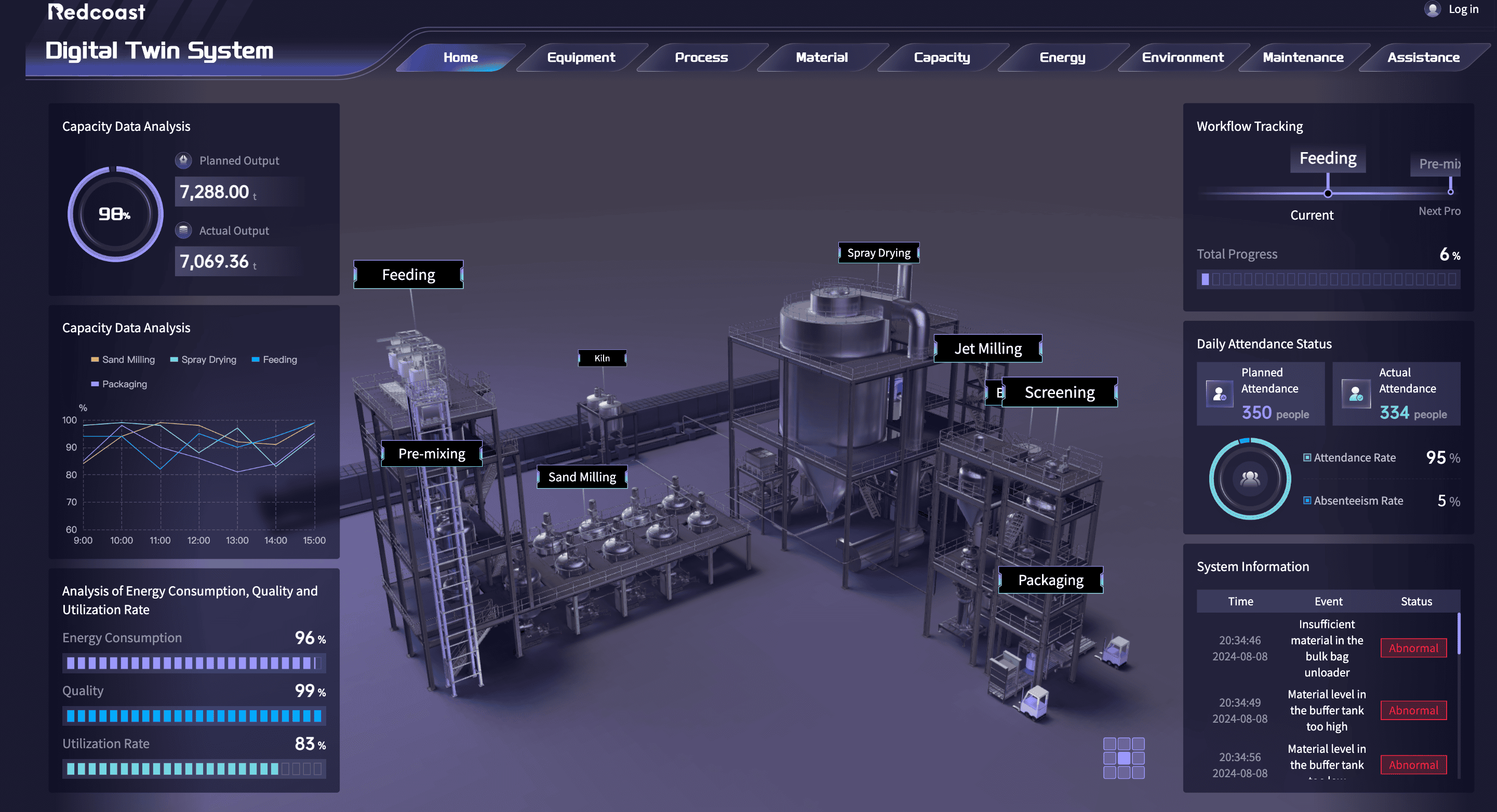
Going a step further, AI can identify quality risk trends in advance and provide adjustment recommendations before problems occur.
This not only reduces scrap losses but also lowers the probability of large-scale quality incidents.
3. Equipment Maintenance: From Planned Maintenance to Predictive Decision-making
Equipment downtime is often one of the most direct sources of cost in a production system.
Traditional maintenance models are usually divided into scheduled maintenance or breakdown maintenance, both of which have efficiency issues:
- Scheduled maintenance may be excessive
- Breakdown maintenance is costly
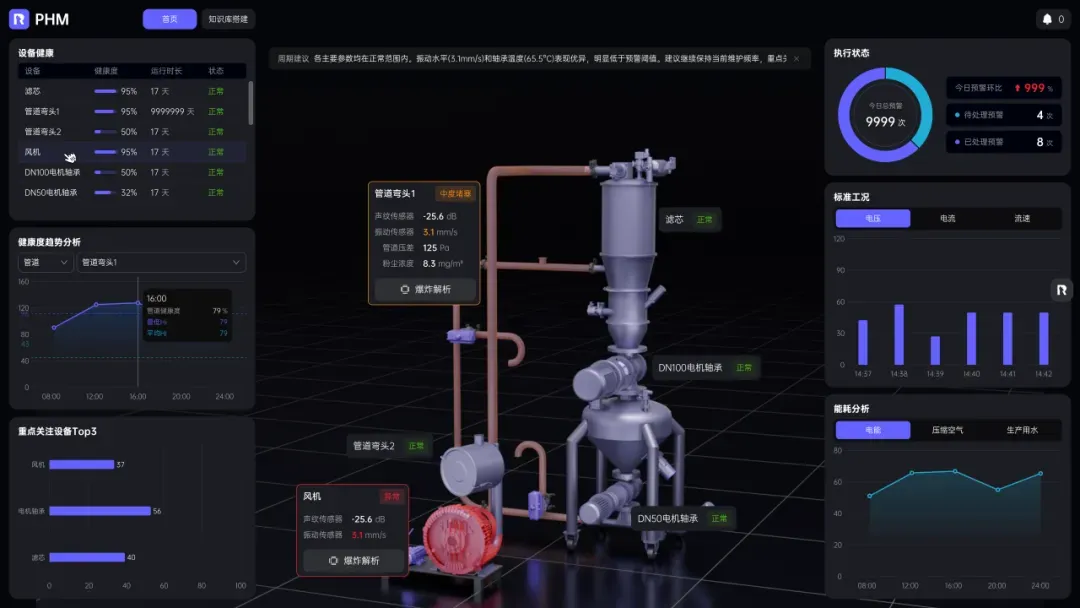
AI agents can continuously analyze equipment operating data, identify abnormal trends, and predict failure probabilities, thereby enabling:
- Scheduling maintenance windows in advance
- Avoiding unplanned downtime
- Extending equipment lifespan
- Optimizing spare parts inventory
When AI is equipped with execution capabilities, it can also automatically generate work orders or adjust production plans, achieving collaborative optimization between maintenance and production.
4. Process Optimization: Continuously Searching for the “Optimal Operating Point”
Production in the process industry often has a dynamic optimal range rather than fixed parameters.
AI agents, through long-term operating data, can continuously learn:
- Which parameter combinations can increase yield
- Under which conditions energy consumption is lowest
- Which states are prone to causing fluctuations
The system can evaluate the current operating status in real time, provide optimization suggestions, and even automatically adjust strategies.
This continuous optimization capability elevates the production system from “stable operation” to “self-optimizing operation.”
5. Control and Management Collaboration: Breaking Down System Silos
Industrial enterprises typically have multiple independent systems, such as:
- Production control system
- Energy management system
- Equipment management system
- Quality management system
AI agents can serve as a cross-system coordination layer, understanding the relationships between different data, and driving collaborative decision-making.
For example:
- Energy price rises → Adjust production rhythm
- Equipment status declines → Reduce operating load
- Raw material delay → Automatically adjust scheduling
This capability enables enterprises to move from local optimization to global optimization.
6. Comprehensive Benefits: Not Just Efficiency, but Certainty
The value brought by AI agents is not merely reflected in point-specific efficiency improvements; more importantly, it lies in reducing production uncertainty.
In highly complex industrial systems, risks often come from unforeseeable changes. Through continuous perception and real-time decision-making, AI makes the system more resilient and controllable.
The ultimate benefits for enterprises include:
- More stable production rhythm
- Lower downtime risk
- Higher resource utilization
- More controllable quality level
- More transparent operational status
In other words, AI does not just help enterprises “work faster”—it enables production systems to run more stably, more accurately, and more predictably.
VII. The Industrial Significance of AI Agents
In a certain sense, the “lobster farming” craze actually symbolizes an important milestone in the development of AI technology: AI is beginning to move from “capability demonstration” to “industrial deployment.”
In the era of consumer internet, AI primarily served content and interaction;
in the era of industrial internet, the core value of AI lies in understanding systems, optimizing processes, and driving efficiency.
For the manufacturing industry, this means that a new era is arriving:
AI is no longer just an algorithm but is gradually becoming a collaborative role within industrial systems.
And when AI truly understands equipment, understands processes, and understands production logic, the smart factory will gradually move from concept to reality.