When AI Ventures into the Deep-Water Zone of Production Lines, What Process Industries Need is “Not Another System”

Redcoast2026-02-09
Over the past few years, “AI+ Manufacturing” has become an unavoidable topic for almost all enterprises in process industries. However, in real-world settings such as lithium battery, new energy, and fine chemical industries, artificial intelligence has not transformed production methods as rapidly as anticipated, and the reasons are not complicated.
The challenge lies not in the inadequacy of AI’s capabilities, but in its difficulty to integrate into existing production logic.
The nature of process industries is a continuous production system that prioritizes stability, safety, and consistency. With highly coupled process parameters and interdependent equipment conditions and product quality, any intelligent attempt detached from process mechanisms can easily become “point-based applications” or one-off projects.
Under such an industry background, for artificial intelligence to be truly implemented, the first question that needs to be answered is not “how advanced the algorithm is,” but rather:
whether it understands the operational logic of process industries and whether it respects the real constraints of the production line.
The Transformation Unfolding in the Industry: From Digitalization to “Comprehensible Intelligence”
From automation and informatization to digitalization, process industries have traversed an extended developmental phase. Systems such as DCS, MES, LIMS, and EAM are now ubiquitous in plants, yet new bottlenecks have concurrently emerged:
- Data continues to grow, yet it struggles to form a holistic understanding across systems and processes;
- Management and decision-making remain highly dependent on experience, with delayed responses to anomalies;
- Experience is difficult to replicate across different production lines and factories.
Fundamentally, these issues do not stem from “insufficient systems,” but rather from the lack of a foundational structure capable of embedding production logic and unifying data semantics.
This is precisely why process industries have begun to re-evaluate the value of the “digital twin” in recent years. It is not another system, but rather a method of unifying the mapping of processes, equipment, and data. Only on this foundation can artificial intelligence be truly “understood” and “constrained,” thereby participating in real production decision-making.
Redcoast’s Starting Point: Industrial Insights Derived from Real Production Lines
Redcoast did not enter the industrial landscape from the internet or general AI domain; rather, as a wholly-owned subsidiary of SOPHON, it evolved from the group’s longstanding practice of serving process industries.
Leveraging SOPHON’s deep hands-on experience in production lines across foundational industries such as lithium battery, new energy, and fine chemicals, Redcoast has a clear understanding of the key constraints in the production process:
Which parameters can be optimized, and which boundaries must be strictly adhered to;
Which issues are suitable for resolution through data and models, and which must rely on the process logic itself.
It is precisely based on this understanding of production line operations that Redcoast did not adopt an “algorithm-first” approach when advancing intelligence. Instead, it utilizes the digital twin as a foundational structure to embed process and equipment logic, and then gradually introduces artificial intelligence capabilities into it.
Digital Twin is not the goal, but a necessary condition for integrating AI into production lines.
In process industries such as lithium battery, new energy, and fine chemicals, production issues are rarely caused by a single factor. Fluctuations in yield, equipment anomalies, and increased energy consumption often stem from the interplay of multiple variables.
Without modeling the overall production process, artificial intelligence can only identify correlations within localized data, making it difficult to form stable and explainable judgments. By constructing digital twin models that cover process flows, equipment status, and takt time, Redcoast transforms production operations from a “black-box system” into a “structural representation.”
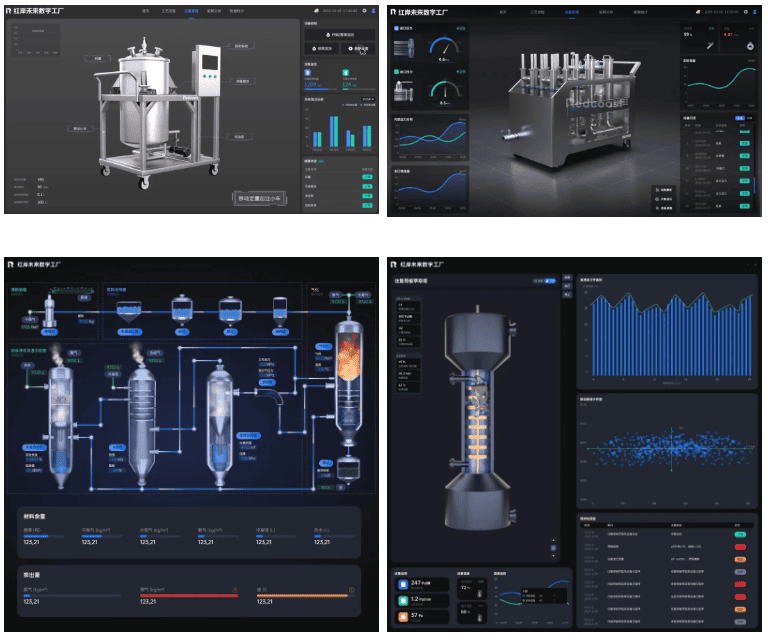
Under this framework, artificial intelligence is no longer an independently operating algorithm, but is embedded within specific process objects and equipment objects, participating in parameter analysis, condition assessment, and trend judgment. This approach enables AI to function progressively without disrupting production stability, and better aligns with process industries’ requirements for safety and consistency.
From “Functional Applications” to “Capability Accumulation”: The Form of Intelligence is Evolving
In the practice of many manufacturing enterprises, intelligent projects are often delivered in the form of “function”: a quality inspection model, a predictive maintenance algorithm, a production scheduling and optimization tool.
As implementation progresses, enterprises gradually realize the core issue: Functionalities can be launched, yet capabilities are difficult to accumulate.
In its system design, Redcoast places greater emphasis on the sustained existence and reusable value of capabilities. Centered around core production factors such as quality, equipment, processes, energy consumption, and safety, it modularizes and accumulates intelligent capabilities, operating them on a unified data and model system.
Across different production lines and factories, these capabilities do not need to be rebuilt “from scratch.” Instead, they can be transferred through parameter calibration and scenario adaptation. This approach shifts intelligent construction from being “project-driven” to “capability-evolving,” better aligning with the long-term operational needs of process industries.
“Tailored to different sub-sectors, rather than ‘one-size-fits-all’.”
Although lithium battery, new energy, and fine chemical industries all fall under process industries, there are still significant differences in process complexity, risk levels, and management focus.
Redcoast does not attempt to cover all industries with a single template. Instead, through modular and scalable customization, it achieves differentiated implementation based on a unified underlying logic:
- In the lithium battery and new energy sectors, greater emphasis is placed on quality consistency, equipment stability, and takt time optimization.
- In the fine chemical sector, the focus shifts more toward process safety, controllable operations, and risk early warning.
Featuring “unified capability and differentiated implementation”, this strategy enables companies to introduce intelligent capabilities suited to their own development stage, without significantly increasing system complexity.
When policies emerge, the direction gradually comes into focus.
The release of the “Implementation Opinions on the Special Action of Artificial Intelligence + Manufacturing’” has not altered the development trajectory of process industries. Instead, it has clarified and accelerated existing trends. The document repeatedly places emphasis on “deep integration into the core links of production,” “replicable scenarios,” and “avoiding redundant construction”, which aligns closely with the real needs of process industries.
From this perspective, the alignment between Redcoast and the policy does not stem from a point-by-point response to document clauses, but rather because its technological path is inherently built upon an understanding of the evolutionary logic of process industries.
True “AI+ Manufacturing” stems from a respect for industry itself.
In process industries, artificial intelligence is not a disruptor, but a “new capability” gradually integrated into the production system. Only intelligent solutions built upon process logic, equipment behavior, and safety boundaries possess long-term value.
Based on digital twins and taking modular capabilities as carrier, artificial intelligence is understood, constrained, and consistently used on real production lines. This path is both a result of process industries’ own evolution and offers a more robust and sustainable practice paradigm for “AI+ Manufacturing.”